When to arrive
Tap an hour, because the avenue runs north to south in the open and the difference between a morning walk and a midday one is shade and heat, not crowds.
What you pass on the route
The avenue sits between two temple complexes, with the river and the city close on either side.
If you only add one thing beyond the avenue itself, make it Luxor Museum: it is on the Corniche, close to the northern end of the route, and it holds a compact, well labelled collection that makes better sense of the temple sites you have just walked between. Go after the walk rather than before, when the heat has pushed you indoors anyway.
What the avenue walk is like
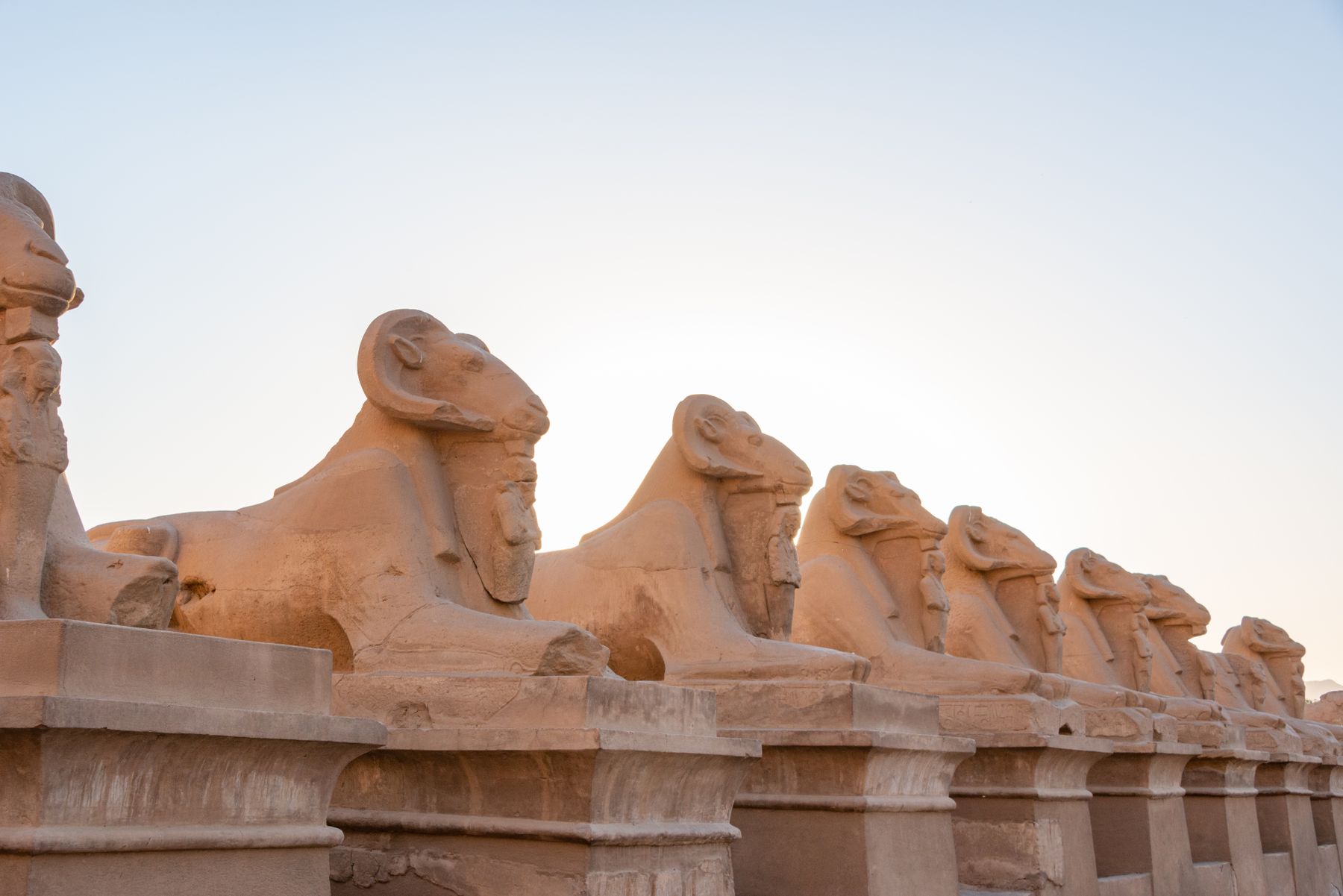
The Avenue of Sphinxes links Karnak Temple and Luxor Temple, a processional route that ran roughly three kilometres north to south. For centuries it lay under houses and streets. Excavation and restoration have put long stretches of the stone paving and the sphinx statues back in view, and it opened to walkers in 2021 according to Egyptian state antiquities announcements. The route is public ground and no ticket is needed to walk it, though the two temples at either end each have their own ticket.
You walk on a paved corridor lined with sphinxes, most of them human headed with a lion's body, set on plinths at fairly even spacing. Some are whole, some are worn, some are fragments. Because the corridor is low and open, you see the city on both sides as you go: the minarets and shopfronts of the modern town, the Corniche al-Nil a short way west, traffic crossing the line of the old route in places.
The walk takes a while, not because it is difficult but because it is long and there is little shade. In winter that is pleasant; in summer the exposed stretches are punishing in the middle of the day. The surface is paving and packed ground, mostly flat, with some uneven sections where the excavation edge is. The fenced areas beside the path are working archaeology, so parts of the setting change from season to season.
Getting there and in
What people get wrong here
- Walking in the midday heat: The path has almost no shade and can be exhausting in the middle of the day. Go early or late instead, and carry water.
- Expecting a quiet ancient site: The avenue runs through a modern city, so you will see traffic, buildings and local life alongside the sphinxes. Treat it as an urban walk with ancient remains, not a remote archaeological park.
- Forgetting tickets for the temples: The avenue is free, but entering Karnak or Luxor Temple needs a ticket. Buy at the official ticket offices at each temple and check the operator's page for current hours.
- Assuming it is fully open at all hours: Parts of the avenue may be gated or closed at certain times, especially at night. Check locally or with your hotel on the day.
- Rushing it as a quick photo stop: Walking the full length takes time and the light changes the experience. Allow at least an hour to walk and look properly, more if you also visit a temple.
Combine it with
The avenue is the spine of the east bank, and most of the main sites sit within a short walk or ride of it.
Questions
Do I need a ticket to walk the Avenue of Sphinxes?+
No, walking the avenue itself is free. The temples at either end, Karnak and Luxor Temple, each require their own ticket. Check the operator's page for current opening hours and ticket details.
How long does it take to walk from Karnak to Luxor Temple?+
The distance is about 2.7 kilometres and takes roughly 30 to 45 minutes at a steady pace without stops. Most people take longer because they stop to look at the sphinxes and take photographs. Allow at least an hour if you want to enjoy it.
When is the best time to walk the avenue?+
Early morning or late afternoon is best because the path is exposed and hot in the middle of the day. Late afternoon also gives good light for photographs. After dark the sphinxes are lit and the walk is cooler, though some gates may be closed.
Is the Avenue of Sphinxes on the East or West Bank?+
It is on the East Bank, connecting Karnak Temple in the north to Luxor Temple in the south. Both ends are in the city of Luxor, so it is easy to reach on foot, by taxi or by bus from the city center.
Can I walk the avenue at night?+
The avenue is often lit at night and some people walk it in the evening when it is cooler. However, access can be limited by gates that close, so check locally on the day. The temples have their own evening hours, which change seasonally.
What should I bring for the walk?+
Bring water, a hat and comfortable shoes because there is little shade and the paving is uneven in places. There are few places to buy drinks along the route. Sunscreen is also useful even in the cooler months.