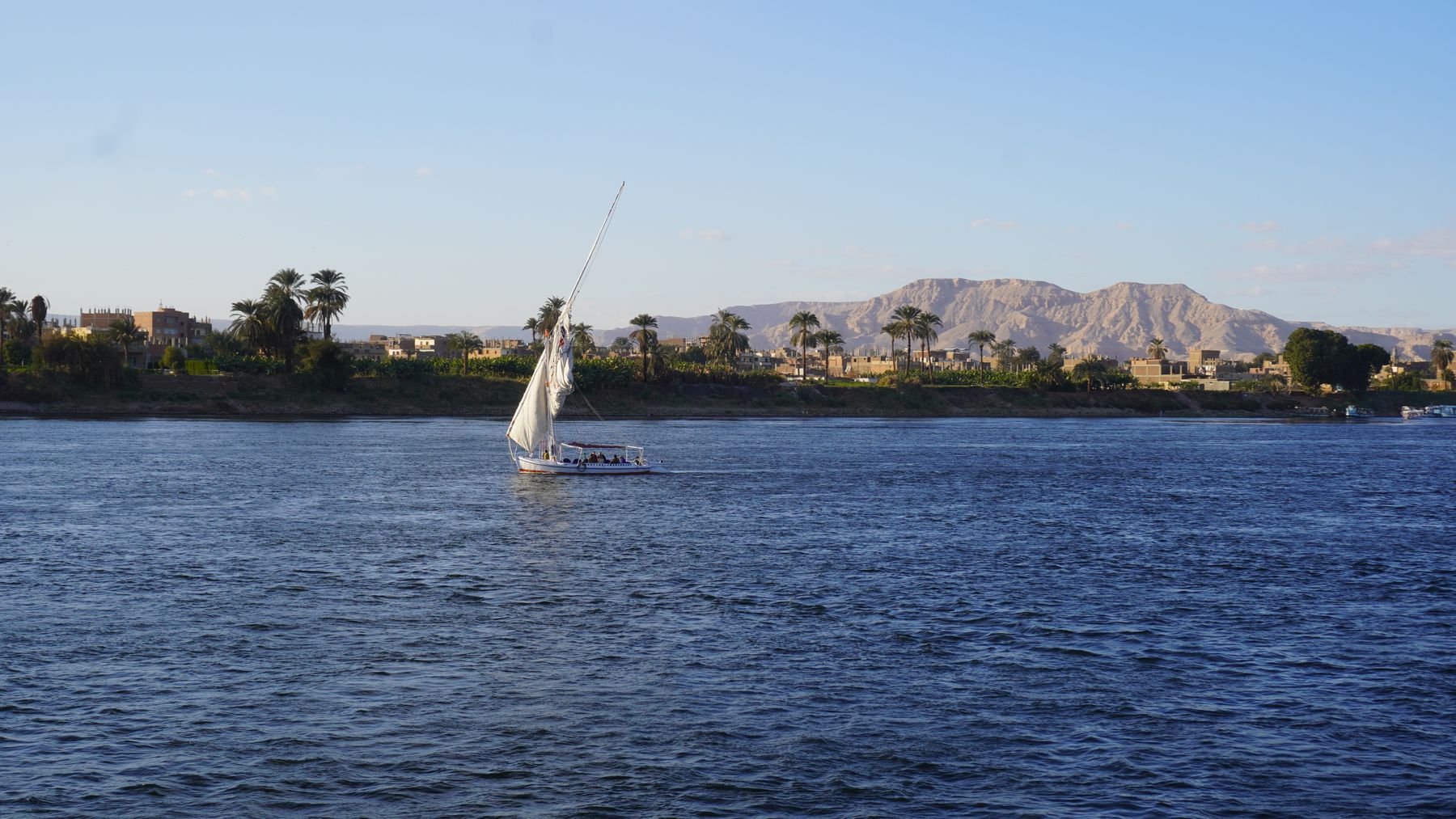
The Nile cruise season between Luxor and Aswan runs roughly from October to April, with the heaviest sailings from December to February. The rest of the year, typically May to September, most boats stop sailing because of the heat and low demand. A few operators sail year round, but the schedule is thinner. This matters less for Luxor itself, which is a year round city, than for anyone hoping to combine a Luxor stay with a multi day river crossing to Aswan.
Why the season follows the calendar
The Nile between Luxor and Aswan is a working river, and the cruise season is set by the same forces that shape the rest of Upper Egypt's tourist calendar. Heat is the first. From May through September, daytime temperatures in Luxor routinely push past what most travelers can comfortably tolerate on an open upper deck with no shade and no breeze, and the boats that do run tend to sail at night and moor through the hot hours. Demand is the second. European and North American tour operators build their Egypt programs around the northern winter, so the charter bookings that fill most of the fleet land between October and April.
Lock scheduling is the third and least visible factor. The Esna and Naga Hammadi locks sit on the Luxor to Aswan stretch, and passage is queued rather than reserved. In high season, when dozens of boats are moving, the queue is long but predictable because operators know the pattern. In low season, a single boat may wait at the lock for hours with no scheduled convoy to slot into, which raises the cost of running a sailing that is already lightly booked. That is why the thin summer schedule is not simply a matter of a few boats choosing to stay tied up.
Sailing windows and alternatives
The options below cover the main sailings and the practical alternatives when the season does not fit.
How to plan around the season
Work through these in order, because each one constrains the next.
Three assumptions to walk away from
What the on board days actually involve
A Luxor to Aswan sailing, or the reverse, is usually four or five nights on the water, with stops at Edfu, Kom Ombo and sometimes Esna or a West Bank site near Aswan. The days are not spent entirely on the river. Most itineraries moor at a temple in the morning, sail during the middle of the day, and moor again in the late afternoon or evening. The direction matters for how the light falls on the temples: southbound sailings reach Edfu and Kom Ombo in the morning, northbound in the afternoon, and the difference in heat and crowds is real.
The cabin is not where you spend most of the daylight. Decks, the dining room and the gangway are, and the quality of those spaces varies far more between boats than the cabins themselves. For anyone combining Luxor with a river crossing, the practical constraint is the flight home: Aswan's airport has fewer direct international connections than Luxor's, so most travelers fly out of Luxor at the start or end. Check the sailing window before booking anything else, because a cruise date that does not line up with your flights undoes the whole plan.
Operators sometimes list a sailing that is not yet confirmed to run. A booking made through a tour operator, rather than direct with the boat, is easier to move if the sailing is cancelled or consolidated onto another date, which happens most often at the edges of the season, in October and April.
When a cruise is the wrong choice
The obvious answer, that a Nile cruise is the best way to see the river temples, is wrong for anyone with less than a full week. Four or five nights on board plus a night or two in Luxor is six to eight days before you have seen the Valley of the Kings properly. If the trip is short, the temples at Edfu and Kom Ombo can be reached by road from Luxor or Aswan as long day trips, and the time saved stays in Luxor, which has more to see than any single cruise stop.
It is also wrong for anyone who wants to move at their own pace. A cruise sets the schedule: you see Edfu when the boat is there, not when you are ready for it. And it is wrong in the summer months for anyone who does not cope well with heat, because the boats that do sail in July and August run a reduced itinerary and the temple stops are uncomfortable at midday. In those cases, staying on the East Bank and taking day trips by road gives more control over when you are outdoors.
Questions
Can you cruise the Nile from Luxor to Aswan in summer?+
Most boats do not sail from roughly May to September, because of the heat and low demand. A small number of operators run year round, so a summer sailing is possible but not typical. Confirm directly with the operator for your specific dates. If a boat is not running, the East Bank remains a full base for temples and city life.
How long does the Luxor to Aswan cruise take?+
The sailing is usually spread over several days, with stops at sites such as Esna, Edfu and Kom Ombo along the way. It is a journey with sightseeing built in, not a short transfer. Plan your Luxor days separately from the sailing days so neither is rushed. For the land based version of the same route, the day trip pages cover the road option.
What is the best month for a Nile cruise?+
December to February has the mildest weather and the fullest sailing schedule, which also makes it the busiest. October, November, March and April are shoulder months with boats still running and generally thinner crowds. There is no single best month, only a trade off between weather and demand. If you are basing yourself in Luxor rather than sailing, the seasonal overview covers the same question for the city.
Do cruises run from Luxor to Aswan or the other way?+
Both directions operate, so you can start in Luxor and finish in Aswan, or the reverse. The direction affects which airport and train connections suit you at each end. Pick the direction that fits your arrival and departure first, then choose the boat. For the stops along the way, the temple pages cover Esna and Edfu as road or river visits.
Is a Nile cruise worth it if I am staying in Luxor?+
It depends on whether you want the river journey itself or just the sights, since Luxor already holds the temples and tombs. A sailing adds the stretch of river between Luxor and Aswan and the riverside temples at Esna, Edfu and Kom Ombo. If you would rather stay put, Luxor works as a single base for a week or more. The longer itinerary shows how to fill that time without a boat.