When to arrive
Tap an hour. The hour matters because the site closes earlier than the Valley of the Kings, and the extra tomb tickets are sold near the entrance, not at the tombs themselves.
What is inside and around
The site holds the village, its temple and the decorated tombs of the people who worked on the royal tombs.
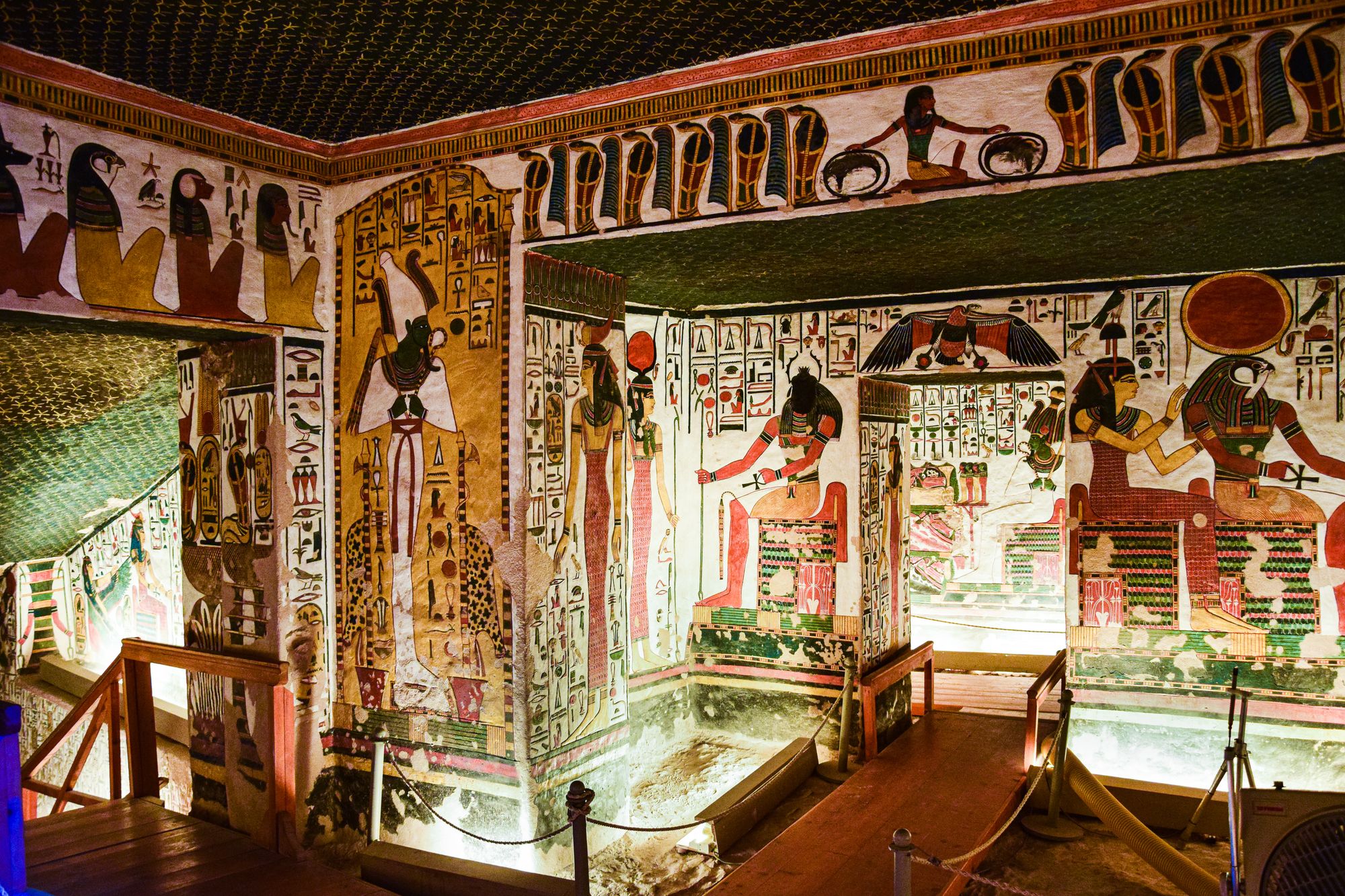
Prioritise the Tomb of Sennedjem. Its painted chamber is the most complete at the site, with scenes on a white ground, and it gives the clearest sense of what the workmen's tombs looked like when finished. If time is short, see that tomb and the village before anything else.
What the visit is like
Deir el Medina sits in a shallow bowl on the West Bank, behind the Medinet Habu complex. It is the village where the craftsmen who cut and decorated the royal tombs lived, and it is the only Egyptian settlement of its kind that can be walked through. The site has two parts: the walled village itself, with its grid of house foundations, and the small Ptolemaic temple of Hathor built over an earlier shrine. The tombs of the workmen and their families are cut into the slopes just outside the village wall, and several are open on a rotating basis.
The village is bare now. You see low mud brick walls marking rooms, a few stone doorjambs, and the street lines, nothing more. The interest is in the scale: small houses, narrow lanes, an enclosed world. The temple, by contrast, keeps its columns and some reliefs. The tombs are the reason most people come. Sennedjem's is the most complete, with painted scenes of the afterlife on a white ground; Inherkhau's has a more varied decoration; Peshedu's is smaller and often quieter. Kha and Merit's tomb is not the one with the furniture, which is in Turin; the burial chamber here is plain, and the fine objects came from a different tomb of the same couple.
Some tombs need a separate ticket from the site ticket, and the extra ticket is sold near the site entrance, not at the tomb door. If you plan to see more than one tomb, buy what you need at the start: staff at individual tombs cannot sell you the add-on. Hours change seasonally, and the site often closes earlier than the Valley of the Kings, so check the operator's page for your date. There is little shade inside the village, and the ground is uneven. The café near the entrance is basic. Allow more than a quick stop: the village, the temple and two or three tombs take time.
Getting there and in
Things people get wrong here
- Buying the extra tomb ticket at the tomb: The guards cannot sell tickets, and the walk back to the office costs time and heat. Buy everything you want at the main ticket office before entering.
- Coming at midday in summer: The site has almost no shade and the tombs are small and hot. Go at opening or in the late afternoon instead.
- Treating it as a quick stop: The painted tombs reward attention, and rushing through in twenty minutes misses the point. Allow at least an hour for the village and the main tombs.
- Skipping the Ptolemaic temple: Many visitors walk straight to the tombs and never see the temple on the north side. It is included in the site ticket and takes only a few minutes.
- Assuming every tomb is open: Tombs close for conservation without warning, and some are only open in rotation. Accept that you may not see a particular tomb on your date.
Combine it with
Other West Bank sites are close enough to combine with Deir el Medina in one day.
Questions
Is Deir el Medina worth visiting?+
Yes, if you care about painting rather than scale. The tombs here are among the best preserved on the West Bank, and the workmen's village gives context that the royal tombs do not. It is a good half day combined with Medinet Habu.
Which tombs are open at Deir el Medina?+
The set changes for conservation, and some tombs are open in rotation. Sennedjem and Inherkhau are the usual highlights when open. Check at the ticket office on the day rather than relying on older lists.
Do I need a separate ticket for the tombs?+
The site ticket covers the village and the Ptolemaic temple. The painted tombs usually need an extra ticket, bought at the main office. Keep the stubs, as guards check them at each tomb.
How long should I spend at Deir el Medina?+
An hour covers the village, the temple, and one or two tombs. Add another hour if you want the noble tombs on the hillside, which are a separate ticket and a short walk away.
Can I visit Deir el Medina on the same day as the Valley of the Kings?+
Yes, they are on the same side of the river and a short drive apart. Most people do the Valley of the Kings in the morning and Deir el Medina in the afternoon, or the reverse if they start late.
How do I get to Deir el Medina from Luxor?+
Take the passenger ferry to the West Bank and then a taxi, or arrange a driver for the day. There is no practical public transport to the site. Allow about fifteen minutes by car from the ferry landing.