When to arrive
Tap an hour: the hour you arrive at Dendera decides how much of the roof, crypt and enclosure wall you can see before the light or the heat turns you back.
What to see inside
The main temple and its grounds hold several distinct areas, some included in the site ticket and some needing an extra ticket.
If you have time for only one extra, prioritise the roof: it gives you the kiosk, open views over the enclosure and a sense of the temple's setting that the ground-level rooms cannot. The crypt is tighter and may not suit everyone, and the birth house and sanatorium are quick stops. The enclosure wall reliefs are often missed entirely, but they reward a slow walk if you have the energy after the main temple.
What the visit is like
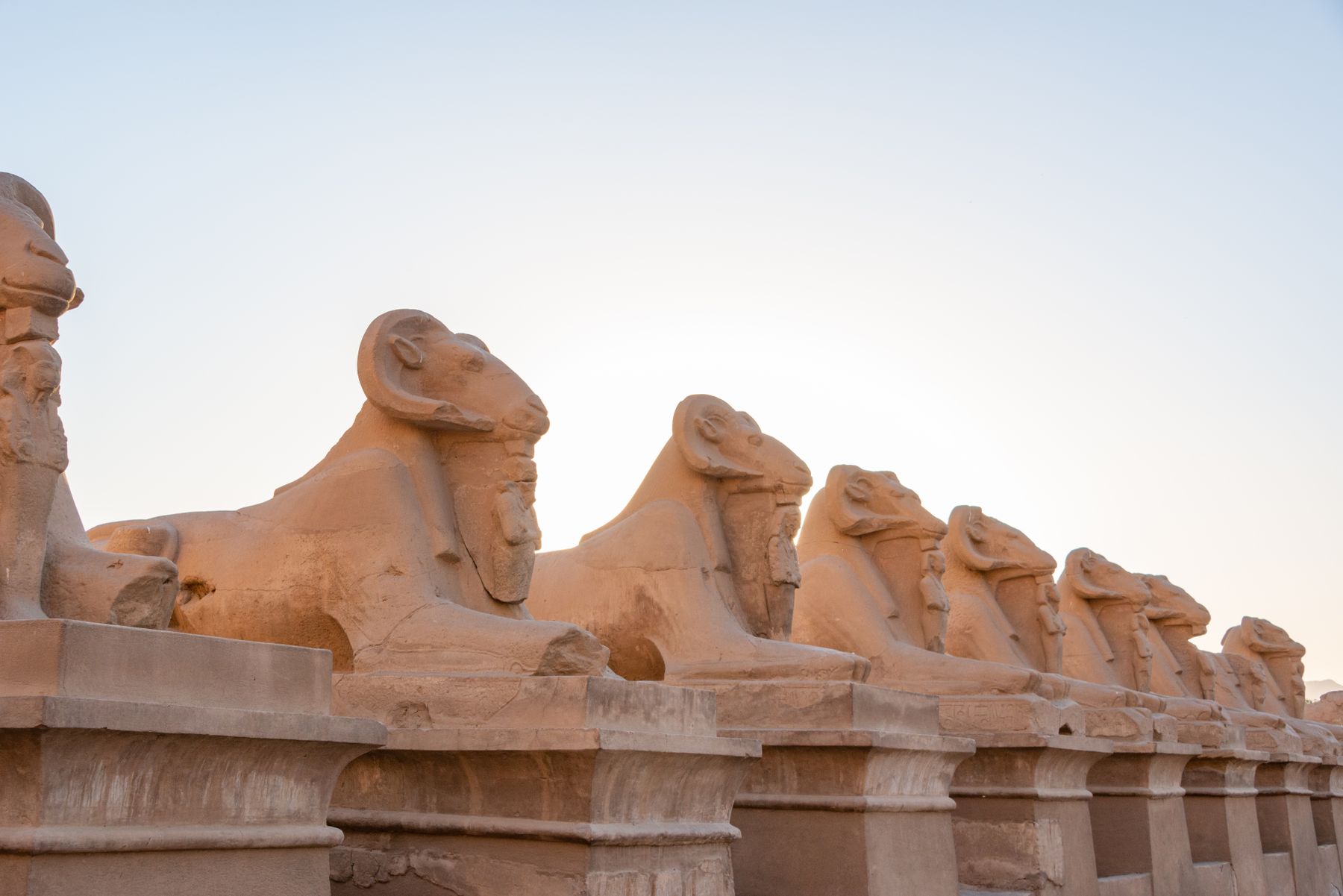
The Temple of Dendera sits on the edge of the desert about 60 km north of Luxor, a walled complex on the west bank of the Nile. The main structure is the Temple of Hathor, built largely in the Ptolemaic and Roman periods, with earlier foundations beneath. You approach through a mud brick enclosure wall, past the birth house and sanatorium, before the outer hypostyle hall opens in front of you. The scale is immediate: columns with carved capitals, a ceiling that still carries colour in places, and a facade that has survived because the sand covered it for centuries.
Inside, the outer hypostyle hall is the first large space, its ceiling decorated with astronomical figures. Beyond it, the inner hypostyle hall leads to the sanctuary, where the naos once held the cult statue. The crypts are narrow corridors cut into the walls, reached by separate ticket; they are low and tight, so claustrophobia is a real consideration. The roof access, also a separate ticket, takes you up to a kiosk with views over the enclosure and the surrounding farmland. The Roman birth house and the sanatorium stand in the grounds, and the enclosure wall carries reliefs that many visitors walk past.
The site is open during daylight hours, but hours change seasonally, so check the operator's page for your date. Two to three hours is enough to see the main temple and one or two subsidiary structures; if you want the crypt, roof and enclosure wall, allow longer. The crypt and roof require additional tickets, sold at the site, and numbers may be limited. The ceiling in the outer hypostyle hall was restored and re-erected in places, so not every block is in its original position. The site can be hot and exposed, especially at midday in summer, and there is little shade.
Getting there and in
What people get wrong
- Treating it as a half day: The round trip from Luxor plus two to three hours on site fills most of a day. Build it as a full day out rather than squeezing it beside another major site.
- Skipping the crypt and roof: They are the parts most often left out and the parts people later wish they had seen. Ask at the ticket window which extras are open that day before you decide.
- Arriving at midday in summer: The courtyard and outer walls have little shade and the heat is at its worst. An early start or a late afternoon slot is easier on the body and on the light.
- Assuming the ceiling is in its original place: The famous zodiac ceiling was removed in the nineteenth century and what you see now is a replacement; knowing that avoids confusion when guides mention it.
- Relying on published hours: Seasonal shifts and conservation closures are common at Dendera. Check the operator's page for your date and have a fallback plan such as Abydos or Esna.
Combine it with
Other sites in the area can be combined with Dendera, depending on your transport and time.
Questions
Is the Temple of Dendera worth the trip from Luxor?+
It is the best preserved Ptolemaic temple in Egypt and the ceiling of the outer hypostyle is unlike anything on the Luxor bank. If you have a spare day and an interest in later Egyptian religion, it is the strongest day trip north of the city. If your time is short, the East and West Bank sites come first.
How long does it take to get to Dendera from Luxor?+
The drive is roughly 60 km and usually takes about an hour each way by car or minibus. Guided day trips often combine Dendera with Abydos, which adds several hours of driving. Allow a full day for the round trip and the site itself.
What is the ceiling of the outer hypostyle hall?+
It carries a famous astronomical ceiling with the goddess Nut and zodiac figures, part of the temple's decoration from the Ptolemaic and Roman periods. The original zodiac panel was taken to France in the nineteenth century. What remains in place is still the main reason many visitors come.
Do I need extra tickets for the crypt and roof?+
Yes, the crypt and the roof stair are usually separate tickets sold at the site on top of the main entry. They are sometimes closed for conservation or for safety reasons. Ask at the window on the day rather than assuming they are open.
Can I visit Dendera independently without a tour?+
Yes, with a private car or a taxi arranged for the day, since public transport to the village is slow and indirect. A guide is useful for the reliefs but not required for entry. If you go independently, agree the waiting time and the return with the driver before you set off.
What else can I combine with Dendera in one day?+
Abydos is the usual pairing, since it lies further north on a similar route, and Esna is a shorter alternative on the way back. Both add time and cost to the day. Choose one companion site rather than trying to fit two.